Copenhagen is just a two-hour-or-so plane ride from London. Yet, for many Brits, it remains unfamiliar. Further, it is often surprising to realise that behind this city’s progressive facade lies a complex colonial past.
Discovering the carefully curated and moving audiovisual tour Voices in the Shadows of Monuments deepened my understanding of a country whose extensive colonial history and interactions with Africa, the African diaspora, North America, and Asia are hidden in plain sight.
The self-paced tour, which is also an art project, is the brainchild of a coalition of artists – Katrine Dirckinck-Holmfeld, who is also an independent researcher, Barly Tshibanda, and Nanna Elvin Hansen. Galvanized by demonstrations and toppling of monuments in 2020, after the killing of George Floyd in America, the trio decided it was time to construct a view of Copenhagen that incorporated the physical traces of its colonial history.
“I think what was really also very important for us in creating Voices in the Shadow of Monuments was that when Black Lives Matter happened worldwide, and we saw like monuments to slavers and colonizers being toppled all over the world, in Denmark, there was this kind of fantasy or idea that this did not kind of belong to us, like this was not part of our history,” Dirckinck-Holmfeld explained.
Congolese-born Tshibanda agreed. “The people here in Copenhagen, you don’t have this kind of idea about how the past is connecting to the present…. It (the tour) was kind of like an invitation, you know, for the people to be aware… to recognize how colonial history connects to the struggle we’re having now.”
The project quickly came together. After reaching out to fellow artists, production wrapped up by early 2022. Pulling from a wide cultural net was important, the creators say. Participants represent a diverse geographical landscape. Jupiter J. Child is from Mozambique, La Vaughn Belle and Oceana James from the US Virgin Islands, Sirí Paulsen and Julie Edel Hardenberg from Greenland, Sabitha Söderholm from Denmark, and Bernard Akoi-Jackson from Ghana.
“History is always dependent on who tells the history. And this is why it was something important to collaborate with the different artists who are also living outside of Denmark, especially from the Virgin Islands. They have this kind of history between Denmark and the Virgin Islands, and also Denmark to what is called Greenland, and then also Denmark to Ghana,” Tshibanda said.
Consisting of audio narratives including sound pieces, stories, as well as visual projections featuring video mapping and public monuments, the tour starts in the picturesque canal district’s Christianshavns Torv (Christianshavn Square), and ends in Kongens Nytorv (The King’s New Square), the city’s largest public plaza. Along the way, it traverses neighbourhoods connected to maritime trade and empire, revealing how closely colonial history sits to everyday life.
The locations and recollections were selected by creators, spurred by the reluctance of establishment historians to help untangle the city’s curated past. “We actually reached out to a lot of historians, like Danish historians, but they didn’t want to work with us because it was too controversial,” Dirckinck-Holmfeld said.
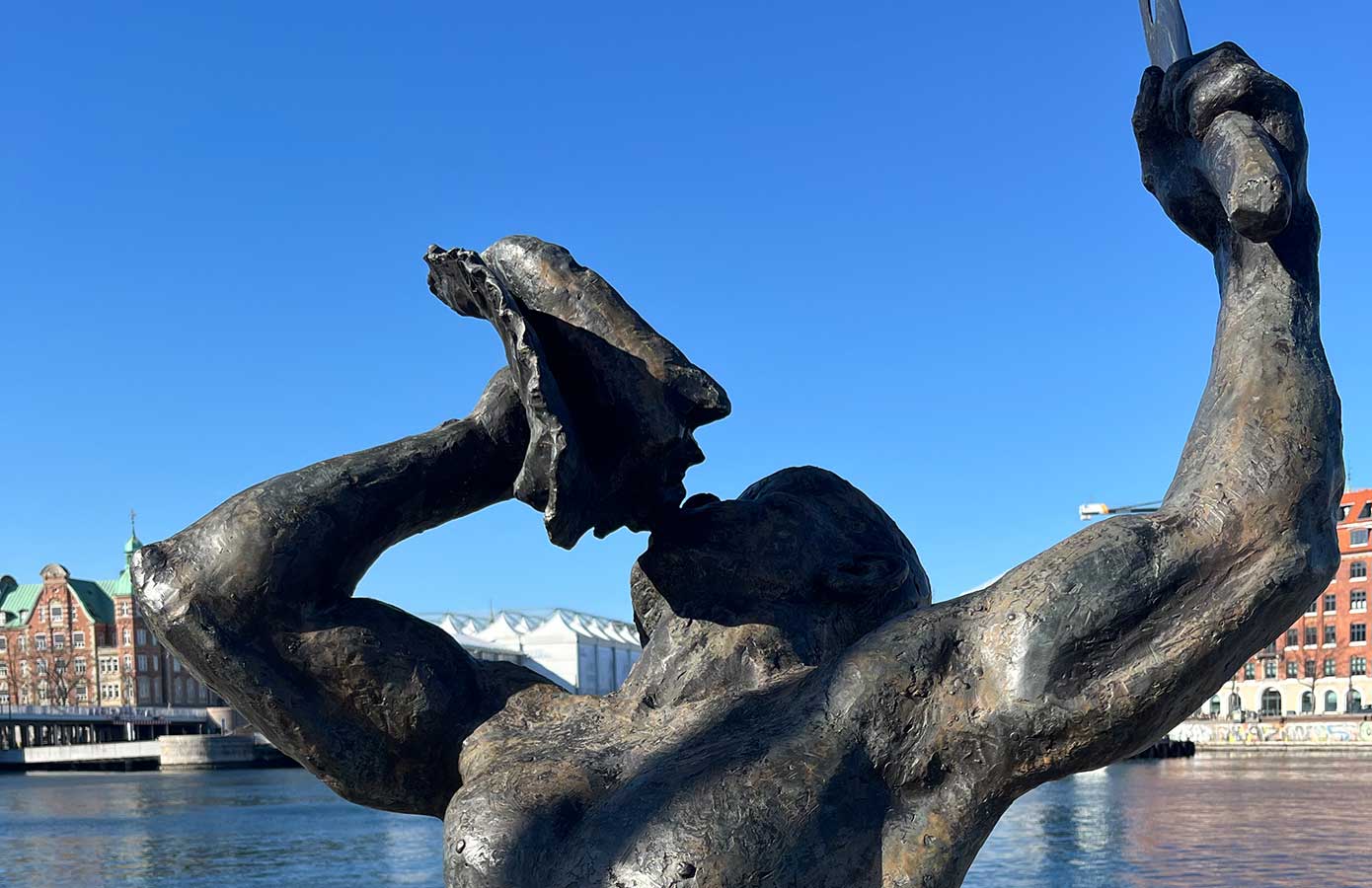
Among the stops that resonated most with me were the tour’s first, the Layer Cake building. I was transfixed as I looked past its innocuous exterior, imagining the four brave women imprisoned there during the late 1800s. Known as the Fireburn Queens, Mary Thomas, Axeline Elizabeth Salomon, Mathilda McBean, and Susanna Abrahamson were part of a legendary group of Black women who helped lead the fiery 1878 labor uprising on the island of St. Croix (then Danish West Indies). Belle, co-creator of the public monument to Thomas, I AM QUEEN MARY, created a voice piece detailing the women’s story specifically for the site.
As I walked back to my hotel after the tour, I realized that my perspective had fundamentally shifted when I recognised the former school, Det Kongelige Vajsenhus (The Royal Orphanage School), and remembered the story of four-year-old Alberta Viola Roberts, who studied there after being brought to Denmark from St. Croix (then part of the Danish West Indies) in 1905. She and a seven-year-old boy were educated there after initially being placed on display as part of a human colonial exhibition at Tivoli Gardens.
The creators hope that the tour and its stories will impact all visitors, no matter their origin. And plans are underway for a second edition, which will include more stops, including the location where the statue of Queen Mary will be placed permanently.
“You have perhaps the new tourists who just get information about the piece and want to have an artistic experience…and then you have the Danes, both natives and migrants..… I would believe that for most who are non-migrants or non-people of colour, they are a little conflicted, because we are still dealing with this issue of exclusivity. Let’s not talk about what brings discomfort, and so that walk can be an intense confrontation with a part of history and a part of Danish reality that you’re not used to,” Childs said.
To take the tour, visit https://www.shadowsofmonuments.dk/