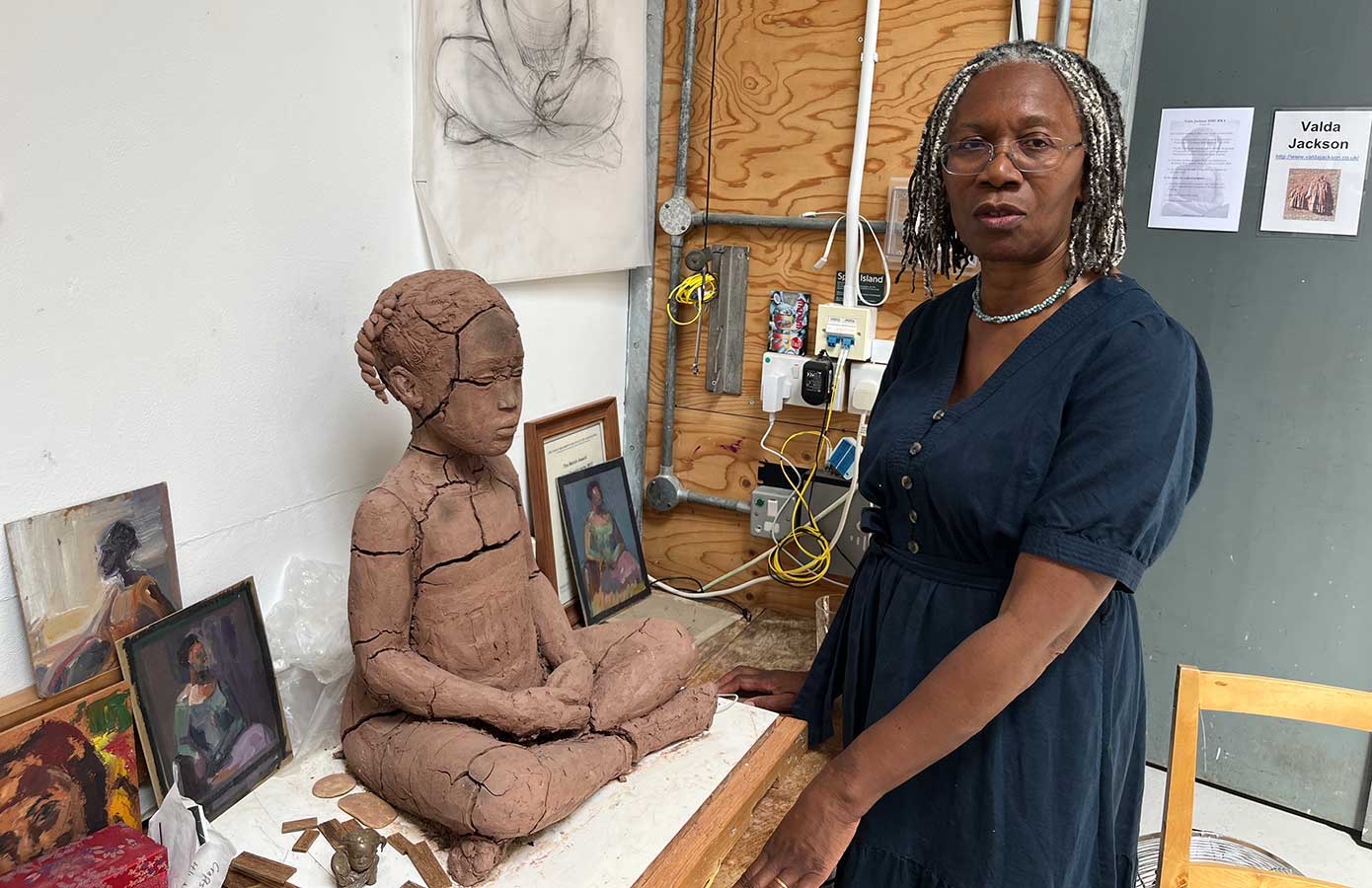
In her Bristol studio, multidisciplinary artist Valda Jackson is turning her attention to clay. Her hands patiently and tirelessly mold the material, bringing it to life. Once shaped, it will bring powerful stories into view.
Known for her sculpture, painting, and printmaking, Jackson explores the psychology of migration, identity, human survival, and the Windrush generation.
Born in Jamaica, Jackson knows about pain – in her case of separation. Moving to England in the 1960s as a young child to join her Windrush generation parents, she has flashes of those early days in her island birthplace. “They are partings, fused sometimes with different levels of distress: my mother’s leaving me and my two sisters, then the three of us leaving our aunt and grandmother three years later and being put on a plane, leaving everyone I knew – my aunt, grandmother, cousins.” However, she is thankful for moments of contentment during that time, including family gatherings and starting school.
While creativity has always been a part of her life, Jackson says she fell into art because “as a child I used to draw because I like telling stories, and it cost little to nothing.”
Jackson combined her childhood memories of moving from Jamaica to England with research on child neurological development to show how long-term separation affects a child’s psyche. She recalls feeling, “A level of confusion, I think. Fear – perhaps the shock of the new. Everything seemed so big. So… loud it felt. And of course I had to meet my mother. I didn’t remember her. I struggled – not wanting to own her, not wanting to actually claim her as my mother. For a while I remember, I called her by name – like everyone else back home.”
She is thoughtful about what she does and the impact on those who experience them.
“I try to bring care into my work, to consider the viewer, the reader. My images and stories are not created to hurt the person experiencing them. I am interested in exploring ways to express something that might be required in a piece of work, even something painful or hurtful without doing further harm,” she explains.
One of her major works, ”Miss Polly,” which resulted in her first major solo exhibition at Bristol’s Royal West of England Academy (RWA) in 2024, captures Jackson’s childhood experience and those of other kids, using a tableau of sculpture, painting, drawing, film, and spoken word.
“Miss Polly” represents the thousands of Caribbean children left behind in the care of relatives when their parents migrated to Britain to find work. They were known as Barrel Children, a term referring to the care packages they received as they waited months or years to be reunited with their families. The clay version of the sculpture is cracked to connect to the themes of separation, loss, and the psychological impact of migration on children left behind.
And though she still pulls on early memories in Jamaica for work, Jackson is now firmly rooted in life in the UK.
“I still say home when I refer to Jamaica. But I also know that where I am right now is my home. I have lived in Bristol for 40 years, and before this I lived 20 years in Birmingham. Only the first five years of my life were spent back home in Jamaica…It was during the 2002 World Cup when I was rooting for any team with the most brown/black players that I came to understand the absolute loyalty of my eight-year-old to Team England. I could never dismiss the importance of belonging after that.”
Jackson’s notable work, including designing the official Royal Mint 50p coin released in 2023 to commemorate the 75th anniversary of the Windrush Generation, and being shortlisted in 2021 to design the £1 million National Windrush Monument at London Waterloo Station, has led to widespread acclaim. In 2024, for example, she was awarded an MBE (Member of the Order of the British Empire) for her services to art.
These days Jackson is working on a memorial honoring the late British-Irish pioneering neuroscientist, Professor Anita Harding, crafting a life-size bronze sculpture that will stand in the grounds of UCL’s new translational Neuroscience Centre in London.
Jackson hopes that her art will resonate with everyone who experiences it.
“I would like to think that my work has a positive impact on young people as well as old. I want, first and foremost, to be putting in front of them something that’s beautiful, something that they can identify with and see in it the grace that is within themselves.
“I also think a piece of work can speak to anyone, and everyone who shows up for it. It can be more – and mean more than just a thing of beauty. It can be something that gives to every viewer, black or white, old, young, of any culture.”
For more on Jackson, visit https://www.valdajackson.co.uk/
See Valda Jackson at work in her studio here.