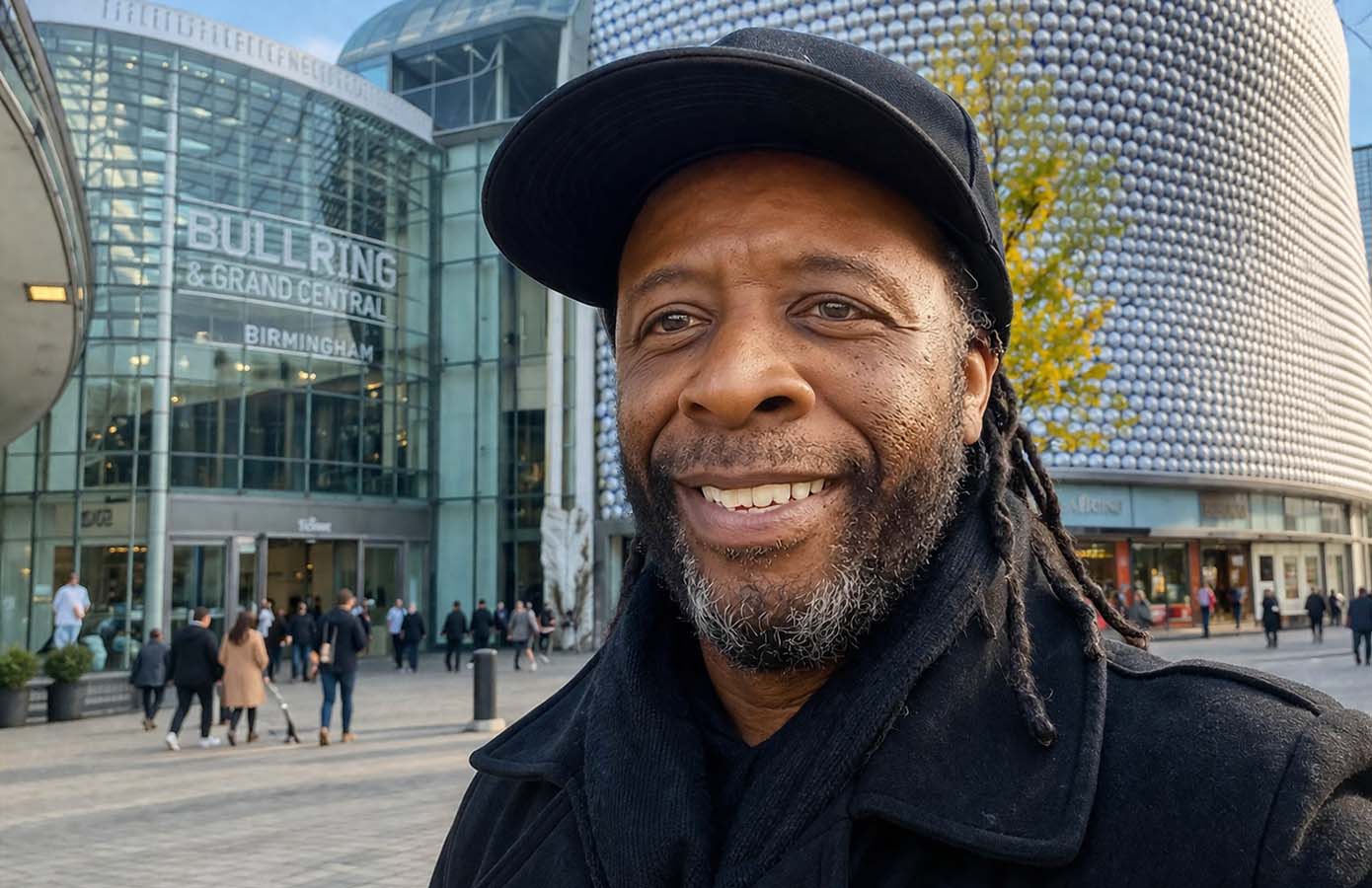
Millions visit Birmingham’s Bull Ring, the legendary landmark in the UK’s second-largest city, but few know that just a couple of miles away, vibrant Black communities have flourished for decades, and their impact has been felt across the region. Birmingham was the site of one of the country’s first Black supplementary schools in 1967, for example, and welcomed the Legacy Centre of Excellence, the largest Black-owned business and arts centre in Europe, in 2019.
Pioneering writer Norman Samuda, however, is well aware of these achievements. Raised in the city’s Small Heath area, his 1982 book, Bad Friday, pulled back the curtain on Black life there. The first UK-published novel by a Black British-born writer offers a snapshot of the Black experience in Birmingham and beyond, as it follows a teenager’s journey navigating unemployment and other economic hardships.
While Samuda is now known for breaking boundaries in documenting Birmingham’s Black presence, when he started writing at just aged 10, his direction was far from clear.
“I tried to pick my influences from what I was watching on TV…and tried to put it into the way that I was living, but I found as I was growing up that that wasn’t working. We were having conversations as young Black kids growing up believing we were equal, but realizing that we were not, so I changed my focus to what was happening with us at that time.”
As a child in 1970s’ Black Birmingham, life revolved around community, Samuda says. “It was like a village where everybody knew each other. Parents knew each other. So if we did something bad on the street, it was told to our parents before we got home, and we would always wonder how did that happen? So it’s that kind of influence that started me writing.”
As a teenager, Samuda would literally hone his craft by helping out in his Jamaican-born mother’s hairdressing salon. He would happily observe clients, using what he learned to make his characters more authentic.
“When I was writing stories, long before I was published, when it came to the dialogue, it was all in English, and when I read it, it didn’t feel right. So I realized that when I was listening to the conversations in the hair salon, in patois, I really had to figure out how I was going to write how our parents speak and how we speak, so that everybody could understand. It took a few years for me to figure out how to write Black British patois as opposed to Jamaican patois or any other island’s patois.”
Over the years, Samuda has written other works, including Britannia’s Children, two collections of short stories, a play, and several poems, all while witnessing the erosion of community collectivism. “Back in the day, when you came to Birmingham, you’d know that the main Black area was Handsworth, they were on a par with Brixton (London), Toxeth (Liverpool). The second biggest Black community was Small Heath, where I lived. When I think of Birmingham from when I was 17, in my 20s, and so on, things were much better. They were simpler.”
The grandfather of nine remembers when the separation started in the 1980s, around the time he and other first-generation Black Brits were coming of age. “As we were having our babies and becoming young families, there was no housing. We couldn’t stay in the Small Heath area, so we had to move out to where there was social housing. The communities broke apart and scattered. Literally and geographically, we have moved from being more of a community to more of everyone wanting to be upwardly mobile, get the house, and move to a better area.”
However, Samuda believes that rebuilding those strong connections is possible. “We just need a place to go. We used to have a place where we met. It’s not a regular thing right now. Anytime we meet up is when you’re wearing black at a funeral.”
For now, though, he is happy to have contributed to his hometown’s story and looks forward to the next iteration. “I hope my work has chronicled our history and progression as a Black community in Birmingham, and somebody else comes along and takes up the story and continues.”
For more on Black Birmingham, watch this segment from the 2018 BBC documentary, A Very British History: The First Black Brummies
https://www.facebook.com/watch/?v=297377184231807